Analogue

More and more these days, I find myself reaching for pen and paper. There is something so comforting, so fulfilling about the weight of a pen in your hand, the rhythmic scratching of lines on paper, the crispness of black ink on white fiber.
I’ve had enough of the incessant tapping of keys and words blinking across screens.
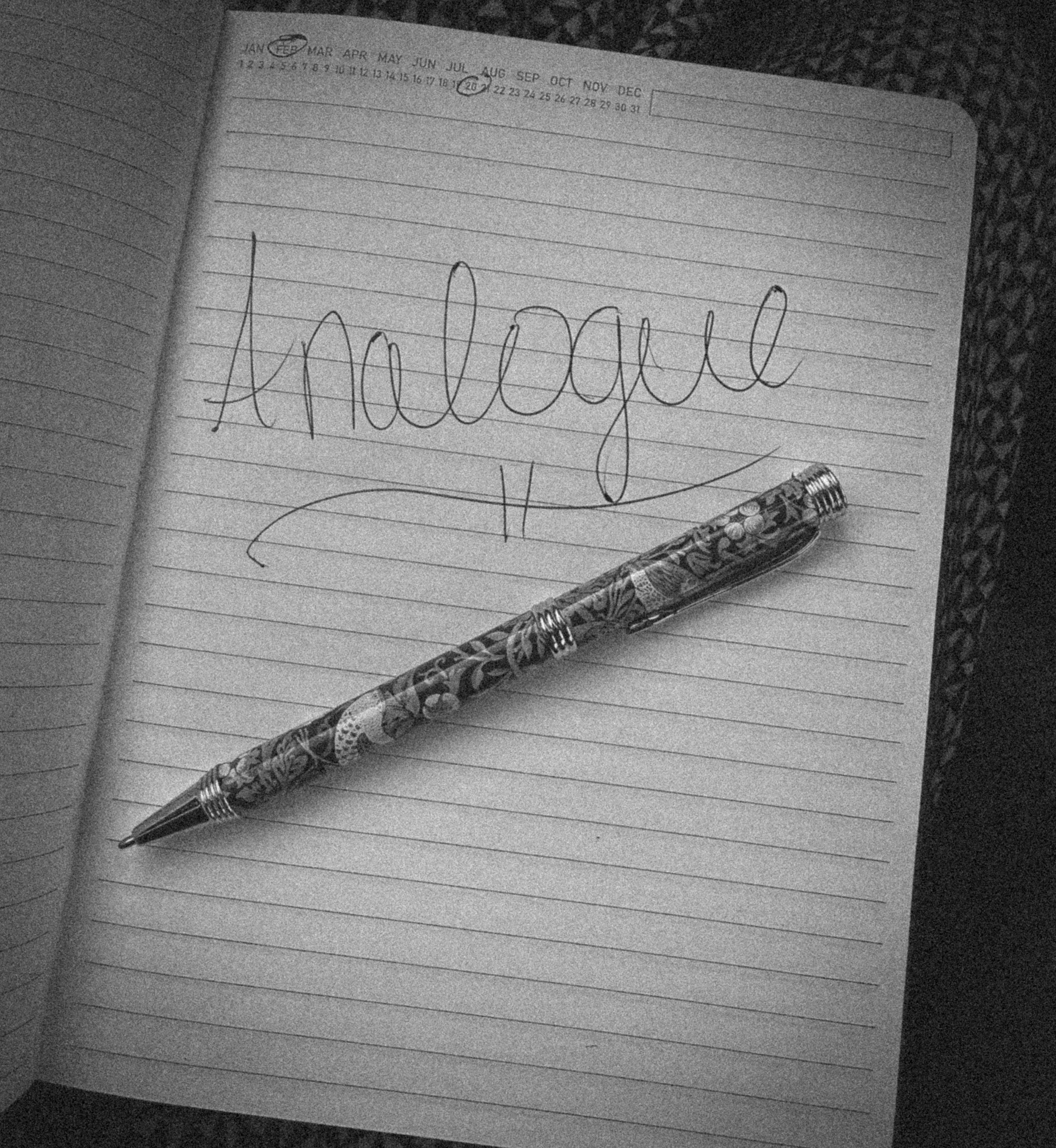
I have an old soul and an analogue brain.
I detest cruise control, microwave ovens, surface-level thinking, and the status quo. My soul, my brain, and my nervous system weren’t built for the noise and chaos of the 21st century.
Perhaps in my past lives, I was a 1st-century priestess of Brigid, a 9th-century cunning woman, and a 19th-century naturalist.
But how will I be defined by my 21st-century life?
How does an old soul with an analogue brain not only survive but thrive in this tumultuous, hyper-digitized world?
i love that many people are going back to pen and paper. it feels more natural and honest
This is beautifully articulated—and it taps into something deeper than nostalgia. What you’re describing isn’t resistance to progress; it’s a recognition that human cognition and meaning-making were never designed to operate at the pace or volume of modern digital life.
There’s a growing body of work across neuroscience, psychology, and even philosophy that supports what you’re intuitively naming: analogue practices—like handwriting—aren’t just aesthetic preferences, they materially shape how we think. Writing by hand slows cognition to the speed of thought, reinforces memory encoding, and creates a tighter feedback loop between reflection and expression. In contrast, digital environments tend to prioritize speed, output, and fragmentation, often at the expense of depth.
Your framing of having an “analogue brain” is especially compelling because it points to a broader tension: the mismatch between ancient human wiring and modern technological environments. The nervous system you’re describing isn’t deficient—it’s calibrated for attentiveness, embodiment, and synthesis. Those are not outdated traits; they’re increasingly scarce and therefore increasingly valuable.
I’m curious—do you see your analogue practices as a form of personal refuge, or are you intentionally shaping them into a framework for how you engage with the world more broadly?